

ABOUT       ARCHIVE          RSS       MOBILE       SUBMIT   
Loading

2/10/2011

Introductions


When I meet a voice carving
masks I forbid that voice to leave
this book. When I meet my voice dressed
up for a disappointing night
when a mite crawls
into a forgotten megaphone, listening.
When I meet speaking out
of turn a voice who breathes best
by match-light. When I meet a measured
silence my voice peels daylight
from beneath her fingernails.

When I meet my voice I listen
to someone else's.

When I meet my voice,
a lost dog.

When I bark.

When I plead
from the knees
of a whale.

When I rummage
through the bones
of a star.

When I meet my voice at a funeral
I did not attend.

My voice who plucks out
three
tongues,
voice who returns to another's
prison, voice who resents the eye
of the undertaker, voice who does not speak
to me, if I un-strangle you
who
will breathe with me?



2/08/2011

Red Horse


click to enlarge

2010
watercolor, gouache, acrylic ink
15 x 21 inches


2/03/2011

Two Men and Millions of Mirrors


‘How can I be like Michael Jackson, I can’t sing or dance!’ Kanye West recently exclaimed in an interview. This comment refers to the rumors that West crowned himself the new King of Pop after Jackson’s death in June 2009. This simply is not true; the publication Scrape (in the same vein as The Onion) created this quote, riffing on Kanye’s large mouth and super-sized ego. However, Kanye has made a number of comments that accomplish the same task, of putting he and Jackson in the same conversation.

He has compared the proliferation of his ‘Kanye Glasses’ to Jackson’s cultural presence. He told The Fader in ’08, ‘It's little pieces of what he had, his level of influence. And it's like that's either the one-off or it's the beginning of a lot of it.’ He references him in his music: ‘Got a light skinned friend, look like Michael Jackson, Got a dark skinned friend, look like Michael Jackson.’ And most recently, in his Thriller-esque experimental short film/music video Runaway, Jackson is the figurehead, literally, of a procession that includes a marching band, a black and red clad Klu Klux Klan gang, and a five-story blow up of Michael’s head circa Dangerous. Yeezy explained to MTV, ‘in relation to the Michael Jackson thing is not the KKK but the concept of cult.’ If you keep putting two words next to each other, over time they start to connect, to share meaning. Reverence becomes more comparison and less homage.

Essentially, Kanye is putting their names in the same sentence and then decrying his horror at having their names put in the same sentence. Self-promoter extraordinaire, he maintains the humility by denying the comparison, then reaps the benefits both ways: as the humble disciple, but one with shrewd eyes on the throne. And either way, it’s great press. Anyone’s name next to Michael Jackson looks good. After the fake story was published, and then reposted on numerous sites, West responded on his blog, ‘IT MAKES ME FEEL BAD THAT OBVIOUSLY I MADE PEOPLE FEEL THAT I WOULD BE CORNY ENOUGH TO SAY SOMETHING SO WHACK AFTER THE PASSING OF AN IDOL, A LEGEND AND MORE THAN THAT A HUMAN BEING WITH FEELINGS AND FAMILY’ (caps his). Other artists mention Jackson -- they can’t not, his legend looms so large in pop culture -- but Kanye does so more deliberately somehow, and cynically. Clearly, whatever Kanye is doing, or not doing, or doing by claiming he’s not doing though we know he’s really doing, is working.

Kanye’s sly allusions are factually inaccurate and morally reprehensible. To say that celebrity is a form of religion is not a new concept. There are faces, personas that are revered, recognized the world over. Marilyn Monroe, Michael Jordan, Madonna (and those are just the M’s) are omnipresent, known to toddlers, to those who have seen the images and heard the names even if they do not know who they are. Michael Jackson has one of the most recognizable names and faces on the planet, ever, and is the most famous entertainer of all time. 99% of people on the planet know who he is, have known for over thirty years. His best selling album, Thriller, has sold 110 million copies, nearly three times ACDC’s Back in Black, a distant second place. For these reasons alone, it is silly of Kanye to back-handedly draw the comparison. Jackson is a pop star come religious icon, if ever there was one. The idolatry that started with Elvis, then The Beatles culminated with Jackson’s celebrity, from his rapturous reception worldwide, including in developing nations, to his all-too-public private life. Sadly, it is this personal life that elevated him to a mythic and ultimately tragic status, and should prohibit offhand references such as Kanye’s.

Not to blaspheme, but on paper, a parallel can be drawn between the life of Michael Jackson and that of Jesus Christ. Both had demanding fathers. Michael’s father Joe Jackson infamously physically and verbally abused him. The issue of Immaculate Conception surrounded both of their lives: in an interview in 1993 with Oprah, at age 35, Jackson refused to admit if he was a virgin or not, because he was a ‘gentleman’. (Imagine another adult celebrity, ever, anywhere, making a similar claim.) He now has three kids and the issue of their conception has widely been debated. Also, there is an aspect of chosen-ness to Jackson’s career; thrust into it far too young by a controlling father, with a talent that he could not deny the world, despite his own personal best interest. But most crucially, both died for our sins.

No celebrity has been more scrutinized, more battered, has suffered for his fame, like Jackson. No celebrity (read: person), ever. From age eight, there was no private life, no ‘life’ in the way the average person understands the term; Jackson’s only existence was a public one, a performative one. And he was too fragile for it. He repeatedly said that he was most comfortable when performing. It was the part of life he knew the best, could do the best. His performative nature and understanding of his place in the world also defined his personal relationships, chiefly his romantic ones. They seemed public, for show. Jackson’s disposition was too delicate, too open to successfully have an adult personal life while being a superstar. He sacrificed himself so that he could give the world his body of work. Other celebrities, like Kanye, relish the attention, revel in it.

Kanye too thrives publicly but his tone is exhibitionistic, narcissistic. Where Michael came across as someone who was sharing a gift, Kanye appears to grab at all the cultural real estate available. Where Michael gave, Kanye takes. He thrives on attention, can’t live without a mirror of millions looking back at him. He performs, gladly, each minute of his waking life. This is why blogging and Twitter are so essential to his over-sharing, overblown, over-everything public persona. Kanye savors any opportunity to be the center of attention, and revolts when he isn’t (the 2006 and 2009 VMAs are textbook examples). He uses Twitter to proselytize his every word, to share his every thought with his fans. This is not unique, but the language he uses and the tone he employs is that of the oracle, of the chosen one. But a chosen-ness, unlike Michael’s, that is self-imposed.

After his recent Today Show interview with Matt Lauer concerning his George Bush comment in the wake of Katrina, Kanye went on one of his now expected Twitter rants which include, though are not limited to, the following comments: ‘I don’t trust anyone but myself! Everyone has an agenda. I don’t do press anymore. I can’t be everything to everybody anymore.’ ‘Maybe Mike could have explained how the media tried to set him up! It’s all a f-ing set up!’ and ‘I can’t be everybody’s hero and villain savior and sinner Christian and anti Christ!’ The first comment is a mere lie; the comment itself is press. The second statement is coyly confessional. He seeks advice from the departed Michael when looking at any aspect of his life is answer enough—it’s merely name-dropping. And the final comment has Kanye’s rapper narcissism shine through, his true colors as self-promoter. The opposite of Anti-Christ isn’t Christian…

Kanye is a self-anointed anointed one. He believes he is shouldering a burden, fame, that ‘everyone will see and understand one day’ (also from Twitter). But, really, he’s just working the game, and expertly so. No one is using the various forms of press better than Kanye. He is everywhere, extending to all the entrepreneurial outlets offered to rap stars, and now he’s directing films. Runaway is ambitious, an orgiastic symphony of every idea, image and feeling he can conjure, has ever conjured. It’s spectacular, but only because it’s laden with spectacle. He’s trying to out-Thriller Jackson, but while Thriller is entertainment at its purest, a landmark of not only music videos but of television, Runaway is pretentious, a series of half-baked thoughts infused with alleged High Seriousness.

It’s a shame, really. With a little less bravado (what would rap be without it?), a little more thoughtfulness, Kanye could be the figure he claims he is. My Beautiful Dark Twisted Family is SO GOOD (caps mine). His artistry and talent—his music—are more than enough. He doesn’t have to be Michael. He’s Kanye.

One of Michael Jackson’s defining traits was his selflessness; of course in his charity work though even his music was about others and otherness. If they were ever about himself, they described how his personal struggles could be applied to his listeners. He always sang from the inside out. Kanye is all outside in. He takes the world, internalizes it, is offended by it, and then sounds off bitterly, noisily. Michael Jackson did not feel scorn; he always forgave the press, his father, the world. The other figure Kanye constantly calls on was similar. He could learn a thing or two.


2/01/2011

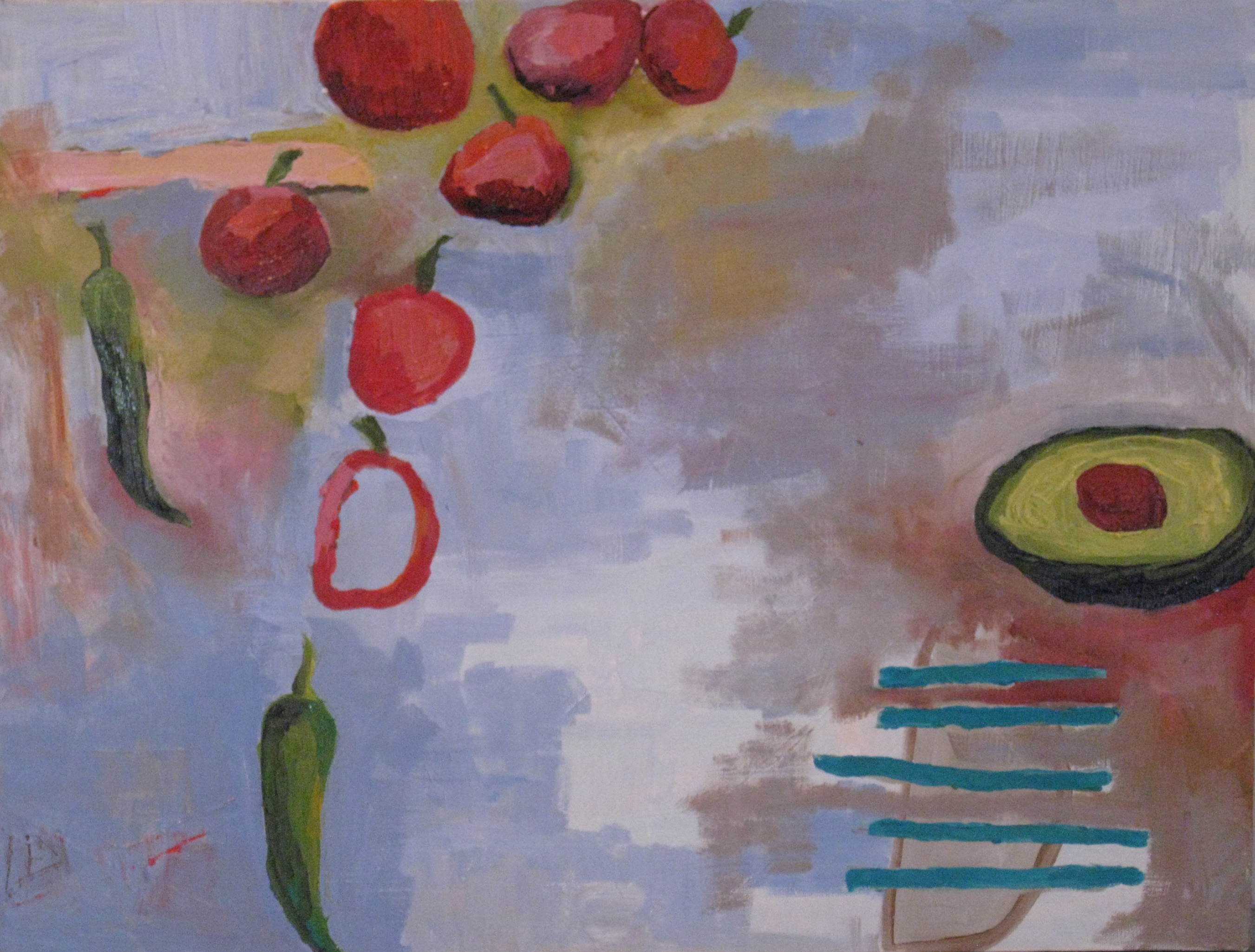
Untitled


click to enlarge

2010
oil
30 x 24 inches


1/27/2011

INRI


A name is something
     you can’t crawl out
from under.

It binds you
     to yourself.

Is that what
     Christ felt
in the garden?

Did his cup
     say this
Is your blood?


“I am
     what you say
I am.”

That was his
     moment of Truth.

A name is something
     you can’t crawl out
from under.

It is nailed above you
     until someone
lets you down.


1/25/2011

Untitled


click to enlarge

2010
oil on canvas
24 x 18 inches


1/21/2011

General Electric


Lately, the rattle of my fridge has been keeping me awake.

Where I live I have to bring my own fridge
or rent one. You know
the kind with a microwave attached.
I have a tube TV.

I was prepared for a year of warm beer,
for doggie bags with early expiration dates.
“Sell by twenty-four hours after the meal.”
But Aaron, he lent me his fridge.

For two weeks I slept soundly
before it reared its ugly head. Bad vibrations.
Did I put it in the wrong spot?
Did I stick it with the wrong magnet?

I've removed, from its top, everything:
The clock radio, the plastic containers.
The clock radio still goes off.
The cold cuts still are cold.

The fridge rattles.
I put it at the foot of my bed.
In the middle of the night
I give it a kick.
Sometimes that does the job.


1/19/2011

1923


he sits on a piece of wood
cracked as toenails
protruding, yellow glances of the Depression still in his cup,
which reeked of cranberries and vodka.
when I woke on Monday morning
his hands were copper and full
with grapefruits and melons he bought from his friend the domino player
and the Oldsmobile would ride proudly, coughing,
to school with me pressed and clad in blue polyester.
the hand wave sneaking through the car window
said so much about the brown in my eyes
and the sunflowers that grew in his garden.


1/07/2011

How to Make Mistakes


Don't do it the way you did
the last time. Inspect each bone
holding you upright. Remove
the most shapely one. Notice
its absence from your body
as you dance. Don't do what
you did before you were born.
No number of warm assurances
will protect you from sharp joy
or its precursor, a shadow
whose touch tints your cheeks
scarlet. Don't do it the way
you were told more than once.
Trust in your oracular organs,
so often silenced by facts.
Don't do it as these words
instruct. They are the silt
of a lived river, unheard
proverbs worn hollow by use,
a careful composition sung
in entirely the wrong key.


1/05/2011

HEAVY CLEANER


collage with paper and paint


12/28/2010

Tulips


Download - Tulips

untitled, 2009
I’m thinking of ways to dismantle my brain
and I’m thinking I might just puke on your grave.


12/21/2010

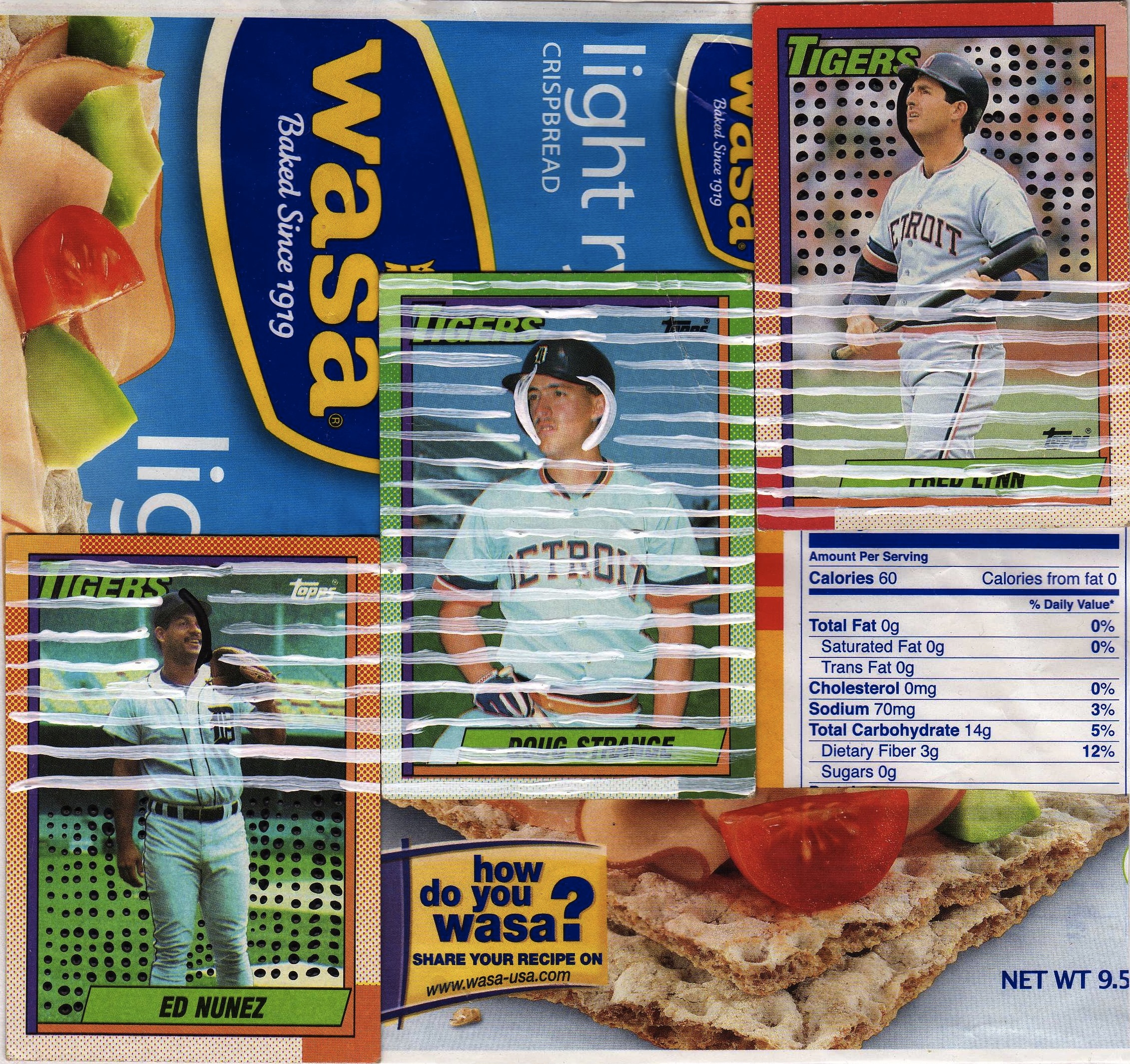
Chrisp Breatt


2010
Mixed medium collage (wasa crisp bread wrapper, 
scotch tape, 1990 topps baseball cards, acryllic)
8 x 8.5 inches


12/14/2010

First Response


My girlfriend has a copper hook inside her.
It is a tiny, T-shaped thing. Perfect to hold a writhing worm,
an inch of flesh pieced by metal. This thing would bob in Lake Oswego,
shining, glittering, ready to be nibbled by fish that sparkle with rainbow skin.

But my girlfriend does not use her copper hook to catch me
or any other scaled swimmer. Her small tool sits afloat in her belly, sends repellent,
a radar of warning. Her copper hook is a fence around the lake.
My bloated fish are not allowed to swim there.

I wonder if it rusts, her copper hook jewelry.
Will it turn that aquamarine green? I wonder, does it pollute?
Will it stain her insides? Will that color seep through her skin?
I would like to have a blue girlfriend.


12/02/2010

Low Loft Reading


12/01/2010

Notes From the B Train: Part 4


View: Part 1, Part 2, Part 3

XI.
I spend the spring working with a new gentleman, Vanya, who appears to be about fifteen but is actually my age. The fact that he has no years on me does not stop him from dispensing all kinds of advice. “Listen,” he starts one day, apropos of nothing in particular. “All I’m saying is that a person’s education is never over – and I’m not talking about school.” And with all the wisdom garnered in his twenty-two lengthy years: “Every problem in life can be solved with math except for women.” I can’t really fathom what he means by this, and math is not exactly my strong suit, but I nod in agreement. Upon finding out I am newly single, he decides to share his courtship experience with me. “I finished my rapid dating phase early,” he lectures. “By nineteen I was just ready to settle down.” Vanya spends a lot of his day acquiring and consuming beverages, among them Mighty Leaf tea, peppermint mochas and the occasional glass of microwaved plum wine; at night, he reminds me, he prefers cognac with the occasional glass of Jack Daniels. “Jack and Coke – that’s the family drink,” he tells me proudly, like this family of Ukrainian émigrés that I have come to know through his screaming phone conversations with his mother thrice daily actually invented it.

Vanya introduces music to our office, which is initially an improvement upon the hums of our servers and the habitually shrieking cashiers. Unfortunately, Vanya has a European’s taste in American music. There is a lot of techno - the booming kind that makes you feel like you’re in a cavernous club where the lights flash epileptically. For some time after that, we spend our days tuned to an Internet radio station called Chill FM. Just happy to be listening to something with words, I express my enjoyment of an Air song. “Just wait,” he says excitedly, inviting me to turn and face his monitor. While I watch over my shoulder, he logs into his Deviant Art account to show me a photograph he took inspired by the song “Playground Love.” It actually depicts a playground, the one just across the street by Restaurant Tatiana. But compositionally I am surprised to find I like it a lot.

Over the course of our months together, several things happen to Vanya. The first is that he falls in love around the same time I fall out of it. “Girl,” he tells his beloved Sasha over the phone, “You want me to bring a bottle of champagne tonight? Tell you what: I’ll bring two.” I type out an email to a friend with more force than is truly necessary: “Fuck love and everybody in it.” Then it turns warm and I fall into a relationship just as Vanya falls out of his. “All these Brighton girls,” he complains, “They just wanna get married.” I have headphones on listening to “Hold Yuh;” I am feeling positive for the first time in a while. In April, Vanya goes to Coachella and returns having discovered marijuana and Burning Man. He seriously considers the idea of growing dreadlocks. This combination of revelations puts him in touch with his long-touted but somewhat latent musical side and he starts seeking my help in writing song lyrics. “Lusya,” he inquires. “What rhymes with ‘inspiration?’” Having concluded that my marketable skill is not so much Russian as it is English, he begins consulting me as his personal spell-check. “How do you spell ‘lingerie’?” he asks. “And ‘stewardess?’ I need this for a really important Facebook post.”

XII.
There are a lot of things I find to be vaguely morally challenging about this job. Aside from translating copy for revisionist pro-Stalin histories – what would my anarchist Russian ancestors think? – I translate promotional articles stating that all girls are born wanting to be moms and wives someday, swallow hard during the racist and sexist jokes, yell at angry babushkas on the telephone and take part in a lexicon of phrases like, “I am watching you” and, “You will be held responsible for your mistakes.” (Everyone seems to have learned their English by watching The Godfather or playing World of Warcraft.) There are days when I think I should get paid twice as much for working in two languages, and other days when I appreciate that I am perhaps only truly required to be half-good at either one.

In June, when I decide it is time to move on, to leave New York and translating behind for a while, I learn that Russians have certain traits that are terribly hard to walk away from: their tradition of buying food for everyone else on one’s own birthday, occasional champagne afternoons, and heated discussions of UFOs and Greek myths. Mostly, though, it is their total laxness hiding behind a veneer of dictatorship; their genuine concern and crazy commitment - even for a girl who wears thrift store sweatshirts - concealed by the stern looks or the constant yelling and shoes so pointy they’d pierce your shins.

It takes two full months to quit my job. I start large by announcing I am moving to Asia. “What are you going to do?” my boss asks me quizzically when I inform him of this. “Learn Chinese?” As if this is actually an insane thing to do, as if he doesn’t read the news, as if learning Russian makes more sense than learning a language spoken by a sixth of the world. Soon he dismisses the idea entirely. “So you’re going to Israel,” he informs me with a bemused grin, because, to him, this is the only country that allows Jews. “And when will you come back?” I tell him I’m gone for good. He smiles merrily and gives me a look of the kind people give during the early stages of relationships, when they’re skirting genuine feeling. “We’ll see,” the look said.

One day in the beginning of July, when I give my final month’s notice, I type this on my phone on the train home: “When I lived in Russia I appreciated most my lack of responsibility for anything except, essentially, staying alive. Even failing classes seemed like it might not have the consequences it would in the States. All my relationships were far away, fourteen hours away, and while this was hard at times, it was also incredibly easy. When I go to work every day, I am distancing myself from all the things that are familiar to me. It has become its own alternate reality, my little Working Vacation on the Beach. I won’t miss the unpredictability of the office clamp-downs, or finding myself locked out of my office because some men need to catch a mouse with their bare hands – “Lusya, step back, there will be blood,” they say, totally serious. But I’ll never work somewhere like this again – at least on many days I hope I never do.”

New York is unbearable, like it is every summer, and my usually peaceful commute gets rowdy as the B train fills up with high school kids on their way to the beach. I tell myself I can’t wait to get out of here. But as the end date approaches, I find myself on a tipsy humid night telling a boy I wish someone could say “Lusya” the way the Russians do. He tries valiantly but I shake my head; it’s in that softest of spaces between the “s” and “ya.” I wake up some weekend mornings with Vanya’s favorite Pink Floyd song in my head, thinking of the way we both confidently sing along to the line, “Hanging on in quiet desperation is the English way,” as though we have any knowledge of English ways at all. I start asking with genuine interest how his artistic endeavors are going, concede that this one abstract photo does, in fact, look a little like Kandinsky if you squint your eyes just right. My boss announces abruptly one day during my second to last week that I am “the best,” and I consider that boyfriends saying it never sounds as good as when he does, his “the” sounding more like “they” and the intonation of the second word rising out of his mouth like smoke. I try to imagine a life where Misha doesn’t sit down next to me at 2 PM every day to eat a banana. If not Marya, who will sneak up from behind and scare me? Who could come up with more diminutive variations for my two-syllable name than Natasha? Probably not the Chinese.

XIII.
I have by now collectively spent days of my life waiting for the B train: in lots of rain and some shine, among beach girls in rompers and aging Russian men in gold chains. I have gotten unreasonably indignant when asked for directions in Russian – this is New York! – but answered in Russian just the same without thinking. I have tried to listen for waves from the elevated platform and seen sunsets over Soviet-style high rises taken straight out of the exurbs of Vladivostok. I have sent text messages in Cyrillic by accident. I have quaked in my Keds dreading to ask for vacation in a language I didn’t feel I understood. I have smiled when I had to concede the Russians were so much more generous than I’d anticipated, in almost every way imaginable.

The trains in Brighton Beach swing toward you around a sharp bend. The B trains are the older kind with orange seats and graffiti and out-of-date ads, and their approach reminds me of the Cyclone roller coaster at Coney Island, just down the boardwalk from my office. There’s the sound of rickety wood and a whoosh of air and the moment when the angle allows you to see both the conductor in the front car and the tail end of the last one simultaneously. It’s not often that you see the start and end of trains, or anything else really, all at once. I remember my first day of work, the start of the period that one day months from now, I’ll call My Slow Descent Into Fluency. I don’t remember the last day, because it turns out it never happens: Two weeks after my last day in the office -- “Will you come back to us a ninja, Lusenka? A spy?” they ask over champagne toasts -- I get a call from Misha. I am back in my hometown for a while before leaving the States. I ignore his call, as I have always done with the Russians, and wait to listen to the message. “Lusya,” he says, not as sheepishly as I would like but still somehow sweet in his resigned tone. “We were wondering. Can you work for us from home?” And I say yes, because I always have said yes to the Russians eventually, because I am not ready, it seems, to say no, to say goodbye for real.


11/24/2010

CARRIER


collage with paper and paint


11/17/2010

Bechamel


The Jutland Peninsula has taken her in,
my cousin—            
like they sheltered Judens during the third reich reign.
She can marry there,
but not on holy terrain
                        because her mom’s not kosher/

She returns to celebrate Christmas on the kibbutz—not kosher,
where I pocketed rabbits—  not kosher—
and ate bacon for dinner with cream— not kosher—
or my aunt who fed it— 
my Dane dame—not kosher— who exclaimed
             “Your tush is flowering with jubilation!”
as I lay frogstyle— not kosher—
on the tile.


My cousins’ son, named Yonatan,
suckles her cheek and teat.
He puckers—  an ingathering of lip pleats  
a kibbutz of sorts—
            the family’s scatter and flock

kibbutz round pagan lights            
kibbutz for soldiers on leave
micro kibbutz on cells and skype
kibbutz on Shabbat
kibbutz parking lot


Yonatan was born off the kibbutz.
like me raised by a daughter of the/   away from the/
who’s parents live on the/
that is no longer    really              a/


My mom’s lips never converged on teats
but rather bottles of fresh cows milk
quickly scattering in refusal
            of fatty                         alien             goods.


I disaffect her-like
Fuck lite.
Gimme more filllin. More skin. more pepper grindin.
More chew.
More melt.
I’ll butter the skillet
loosen my belt
ladle and lip grip
taut sacrament
relinquish the bet
drop Hannukah gelt
affix  ‘il’ to Lent/
            and reminisce of schnitzel corn and rice—delight

Persons of every generation must view themselves as having been
individually freed from the land of Egypt


After the Pageant


the dining hall
                                                has dissembled dismembered

every generation individuated itself, to free(ify) itself

Egypt melts in a cast iron pan/

the fingers of my hand kibbutz to gesture            wait

as of late

soldiers kibbutz on Gaza.

while we—like milk and butter—


cream.


11/10/2010

Articles From Grandma


11/02/2010

Step Down


Too many in the post office line. Each one

clutches his parcel and his woe is me.

Think, of course, of the stove, the lamp.

Go outside if the rain peters out or sleep

when the construction quiets down.

After the morning glories closed

you gripped the chicken wire just in case

the wind came to rattle you away with

the seedpods. Just maybe the stove,

your blackened kitchen. At the grocery store

the loaf goes stale before you can buy it.

A man behind you spit shines his child

when she squirms herself to tears.

Stand straight and stay still. The light

gaping out at the empty room.


10/28/2010

Notes From the B Train: Part 3


View: Part 1, Part 2

VIII.
Winter comes to Brighton Beach, and as it turns out, winter there is barely acknowledged. The thermostat does not appear to ascend past 60 degrees and my pal Misha rubs his hands together for warmth over his keyboard. I turn so my feet are pressed against the cozy computer hard drives. We all wear hats and nurse hot beverages; I buy larger coffees. Friends in their first years of employment elsewhere across the city are thrilled by the realization that snow days exist in their professional worlds. I scoff and trek to work through snow up to my knees. “You think Russians are going to shut down because of snow?” I ask, followed by a requisite dramatic pause. “They invented snow.” This is, I suppose, what I talk about when I talk about Russians – their vodka and blizzards and great fur shapka hats - because it is easier than saying almost anything else, anything more nuanced or complete.

It’s the second half of my first year with them. With my hands on the keys and eyes on the screen, the Russians keep passing around me. They bustle and lurk, yell maddeningly and conspire in whispers, they laugh and they eat. A girl cuts her foot on glass. “Where is the vodka?” is the first question someone asks. On another day, a different girl cuts her hand. “Why isn't life easier?'” she wonders through tears with her hand under running water. “Come on,” says another Russian impatiently. “Who would want to live an easy life?” I concede that this is a fair point but I am not sure that it is.

My office is small and windowless and closed to the natural elements, but it hums and swells with philosophical questions and spiritual contemplations, with mixed-language idioms and jokes. I am drinking tea on a break and evaluating the state of my nails. “Lusya,” says a woman I am sure I've never met. “What are you thinking about so seriously?” Moved by the Russian spirit of things, I answer with seriousness, “Life.” The woman, who is somewhat brusque, flashes her gold teeth at me in approval.

Over lunch, conversations of similar import commence. Is the lychee fruit related to a leech? Is couscous the American kasha? What exactly is a bad romance, in the GaGa sense? What are the origins of the term “Limp Bizkit?” Is being married on the Sims really so different from being married in real life? Are we all just controlled by aliens? Where can you find a decent banya in this town, one where you're allowed to sip beer while you steam? In the morning, Vanya asks me how I am. “I'm fine,” I say like an American, but in Russian. “And you?” “Everything is terrible,” he says. I spit out my coffee laughing, but I should know better, that he is serious, because Russians are when it comes to these things.

IX.
As the only possessor of a United States birth certificate, I am exempted from staff meetings and USSR t-shirt uniforms, but I sense that I am a step outside the ring in almost every other respect as well. This constant need to prove yourself on behalf of your entire culture makes, it turns out, for an exhausting way to spend your days, and there are a number of occasions over the course of the year when I think I might give up the Russian racket for good, get out of the business and back into English.

Over time I realize that I am prone to forgetting that the strict militancy of the Russian environment conceals the fact that there are actually no rules at all. The law of Brighton Beach is that there isn’t one: you can do whatever you want, more or less; a hangover or a desire to go to the beach is, after the most unconvincing sigh or slightest good-natured berating, a perfectly legitimate reason not to come to work. But arriving in the office each morning as an American, raised in the great tradition of defense as the best offense, I feel compelled to offer excuses for my behavior, the good and the bad, and grandiose reasons for any absences. I find that for as many things as I do not understand about them – the constantly raised voices, the endless appetite for mayonnaise – there are a lot of things the Russians do not understand about me: my willingness to wear used clothing or scuffed shoes, how I can be a Jew without a last name like Goldsteinberg, what exactly I, as a vegetarian, eat and how I stay alive, so far from my mother’s home cooking, too. But one thing Russians are very good at understanding is chaos, the dramatics of love and family, personal crises, the kind of lack of direction or tendency toward major life upheaval that may or may not afflict you, intensely and suddenly, when you are twenty-two or twenty-three.

This all comes to a head in March, when a trip to visit family turns into one of these crises, just the post-grad kind, the end-of-a-long-relationship kind. As soon as I get back to New York I decide I have to leave again, and while I am prepared to work off-site – “Telecommuting,” I tell them like I know anything about business at all, “It’s very popular in American management” – I am also prepared for the likelihood that I could be fired. But instead of chastising, the Russians swing into action, full of advice, completely in their authoritative element. On the hunt for an apartment, I ask Misha if he has ever moved within New York before and if he might recommend a moving company. “Oh man,” he says. “You’ve got me. I still live with my parents. I tried to move out three times but my mom just wouldn’t let me.” When I announce with exaggerated optimism that I am moving in with male roommates in Crown Heights, the reception is as though I have announced I’m quitting drinking during a long winter; there are sharp exhalations, some muttered disbelief at how far I’ve fallen and intimations of, “This can’t last.” Several people suggest I move to Brighton Beach instead. I entertain the idea so far as a cursory Craigslist search and setting up an apartment visit, but at the last minute I back out and don’t show. There can be, it seems just then, distinctly too much Russian in one day.

Oddly, when I return from my second trip away from New York, my employers are moved by some sort of pity or regret or other kind of mysterious Russian logic to promote me. My boss corners me and asks me about my plan for the future. Being the kind of person who consults airline ticket prices so frequently I know which days a month are best to fly from New York to LA or from New York to Chicago, I do not like to commit to any kind of plan that might keep me in one place. I swallow and tactfully say that I enjoy working with the business and hope to continue working with it somewhat longer in whatever capacity both parties agree on. My once mainly academic and survival Russian vocabulary, full of words useful for describing the Imperial legal system or ordering Baltika beer, has taken a turn toward “amateur lawyer with a taste for idioms.” “How long will you stay with us?” my boss wants to know. I say six months with a question in my voice. He says a year. I counter two years. He suggests three. It is bargaining, the Russian way of life, the trait I find to be most frustrating and advantageous at once. By the end of the conversation, he too has offered to find me a studio apartment in Brighton Beach to spare me a commute and keep me close to the fold. He takes particular joy in imagining depriving the MTA of the $89 I pay for my monthlies. The thought of relinquishing my Metrocard seems like a fate significantly worse than unemployment. “We’ll see,” I say, which is a phrase Russians like very much and use to signify the end of many conversations, their special non-committal yet all-knowing refusal to ever concede the last word.

X.
For a while, moved by enthusiasm and perhaps some post-holiday rush boredom, my boss decides to try convincing me to work longer hours, preferably ten hours a day, six days a week. For various reasons, chief among them my embarrassingly meager pay -- although spending most of my waking hours confined to a space where people think microwaving fish is acceptable is also an unappealing prospect -- I do not find this to be a reasonable expectation. I spend a week refusing to submit a new schedule. “Ten hours is not possible,” I say. “I have classes, I have another job, I have things to do,” trying a new excuse every day in the hope that one will strike my boss as sufficiently convincing, but he doesn’t give up. “Well, what’s wrong with nine and a half hours?” he asks reluctantly, like he is sacrificing something major and not just a few hundred words about translations of Dr. Spock books. After work, I fume to a few friends. They are Jewish and sympathetic. “Didn’t our great-great-grandparents work 18 hour days for their Russian overlords so they could emigrate and we wouldn’t have to?” someone asks. I outwardly agree, as carried away by American indignation as I was before by Russian moral meditation, but I stop to consider that our ancestors’ Russian bosses presumably did not try to lure them in with afternoon sake or pirozhki.

The Russians get more comfortable with me as time passes and spring arrives. When the men ask me to name my favorite alcohol and the women start asking to borrow money, I know I am more or less part of the family. They enjoy sharing with me their vast repertoire of Jew jokes, as though they believe that as a Jew I might especially understand and relate to them. When I cannot bring myself to laugh uproariously they think I may not understand. “You see,” Misha explains with patience, “It is funny because there is a thought that the Jew people are very stupid and greedy.” After a pause and a bite of potato salad he asks breezily if “Hava Nagilah” is my favorite song. Still, they take nearly endearing pains to assure me that I am not quite as bad off as other members of my culture. “You have some Irish heritage, yes? Don’t worry, that is much more important. Your children will be great drinkers.” I am not sure what scientific grounds they might have for this conclusion, but as with much of the dubious information they present as indisputable Russian fact, I accept it tacitly and with a tight smile. It is not often that I actually disagree with them entirely, but they are not to know that; such is the nature of our bond: the old believers and the new disbeliever, the confident and the skeptical confidant, the Slavs and the American.


10/19/2010

Snail Talk


Growing up in Los Angeles, I took walks around the block and found myself stepping on a lot of empty snail shells. The sharp, crunching noise kept me coming back to this one spot, guaranteed to be overloaded with empty snail houses. I never liked the gooey ooey part of the snail, and to this day I hate worms. They are gross. They don't have that nice shell to cover up their grossness. But snails have since grown on me (idiomatically, not actually grown on my body). In fact, I kinda love them.

A couple weeks into the snail house-wrecking period of my life, I was at the car wash with my mom, waiting and being bored and 6 years old or something. There was a weird gift shop vibe at this car wash. It was as if the car wash dudes were thriving off the bored little kids who got tricked into going on errands with their parents. There was this spinning puppet rack, like the kind you'd see in a toy store. Of all the fluffy and soft animals I could stick my hand into, I chose the snail puppet. My mom bought me Snaily, the snail puppet, and from then on out Snaily officially came with me everywhere I went. Here is a picture of Snaily and I, dinning.

It is easy to imagine Snaily’s fate resembling Woody’s in Toy Story 3, just chilling on the bed, waiting to get played with. But Snaily was actually a big hit in college. Rather than just a puppet, he was kind of a comforting glove. You put Snaily on your arm and you can still pretty much do anything you would normally do, it's just a little funnier looking. You forgot that you were wearing a snail and went about your business - eat a banana, turn off the light, something. My friends' evolving intrigue in Snaily and their appreciation for my random interest in all things snails made it easy to get me birthday gifts. I started to rack up on the snail paraphernalia. I left college with a snail lamp, a snail clock, a couple snail candles, a snail necklace, an I <3 Snails magnet, a snail-print cloth from straight-up Africa, a couple snail shirts and the list goes on. Nowadays, people send me sweet images of snails or photos they've taken and think of me when anything snail-related is involved.

Anytime the moment arises where one would need to draw something on a wall, or carve their name in a tree or just generally graffiti (pretend that's a verb) something, out comes a snail. It's a nice go-to and I feel pretty lucky to have it. The other day in the subway, I saw someone had drawn a snail smoking a cigarette on a poster. I think I have a doppelganger out there. That's cool.